
Return on Investment
A Trillion Dollar Bet on AI

A few American companies are transforming their businesses and the American economy on a scale not seen since the railroad buildout in the late 1800s. Datacenter investments have led to 50%+ growth in hyperscaler assets over the past year.
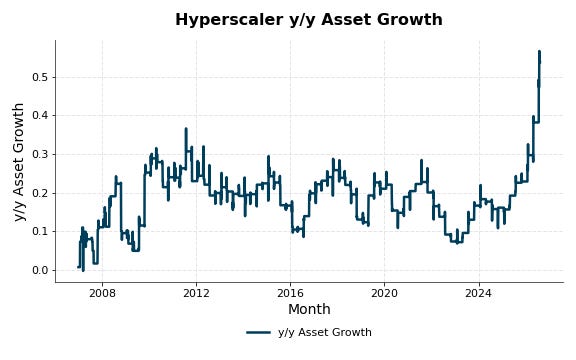
While the rest of the economy is following through with expansive investments of their own, those investments pale in comparison to the balance sheet expansion we’ve seen by the hyperscalers.
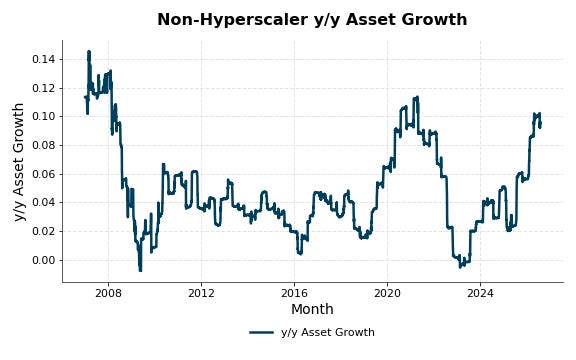
The trillion dollar question remains, will hyperscaler investments pay off for shareholders?
The Investment Factor
While there is no definitive analysis to lead investors through such an unprecedented moment, we do have past analogies and generalizations to guide us.
Research data by Fama/French on the Investment factor splits the stock market into 5 portfolios based on year over year asset growth. How have the returns of high investment businesses fared vs. those of low investment businesses?
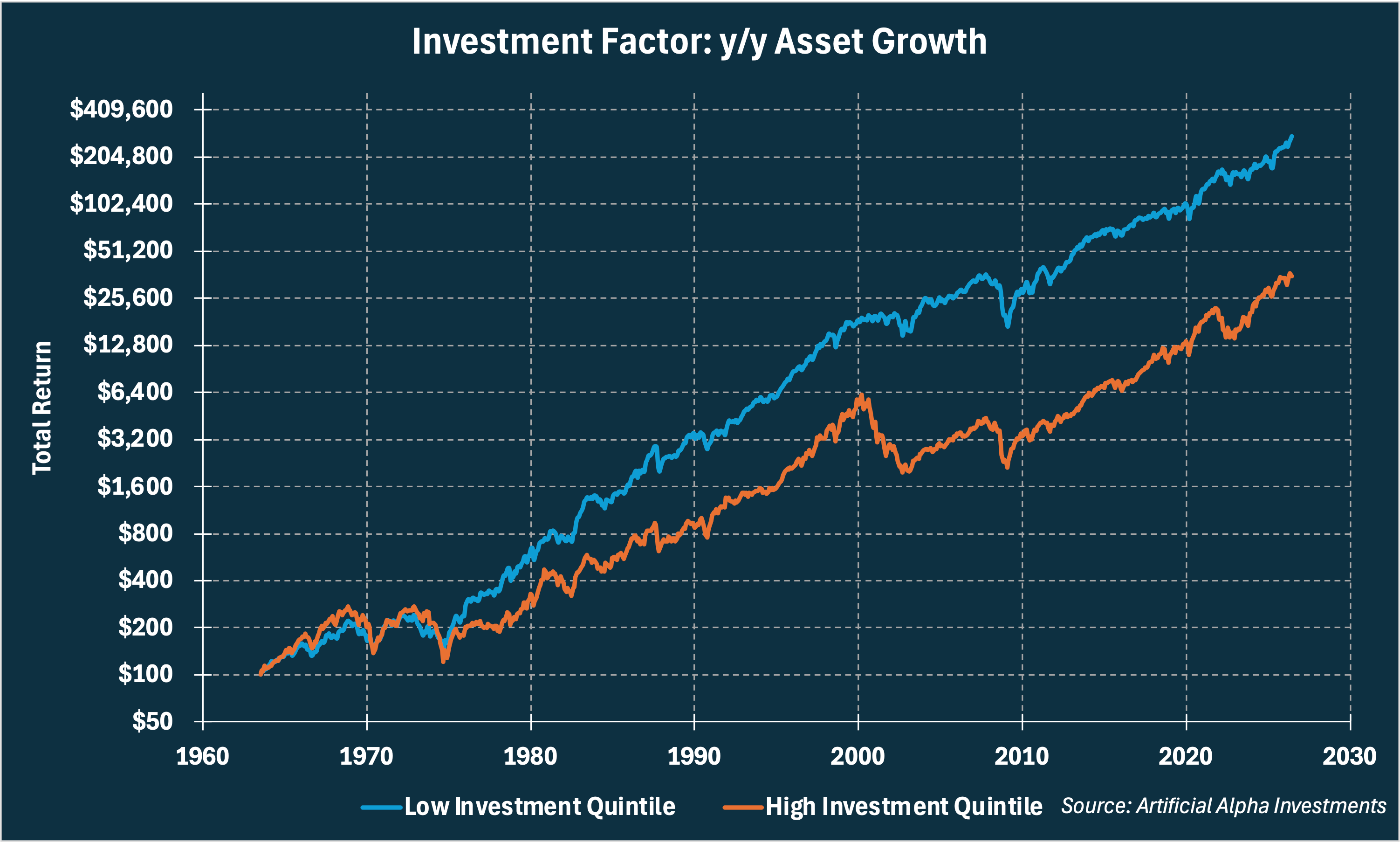
Based on many discussions with clients about Artificial Alpha positioning and philosophy, the results are perhaps surprising. Businesses that invest most aggressively in hard assets have historically delivered the worst results. This was especially true during the telecom and fiber buildout of the dot-com boom, the biggest private investment event in the sample.
The underperformance of high investment businesses surprises me because such spend has wildly unknown ROI and investors (correctly) have an association between risk and return.
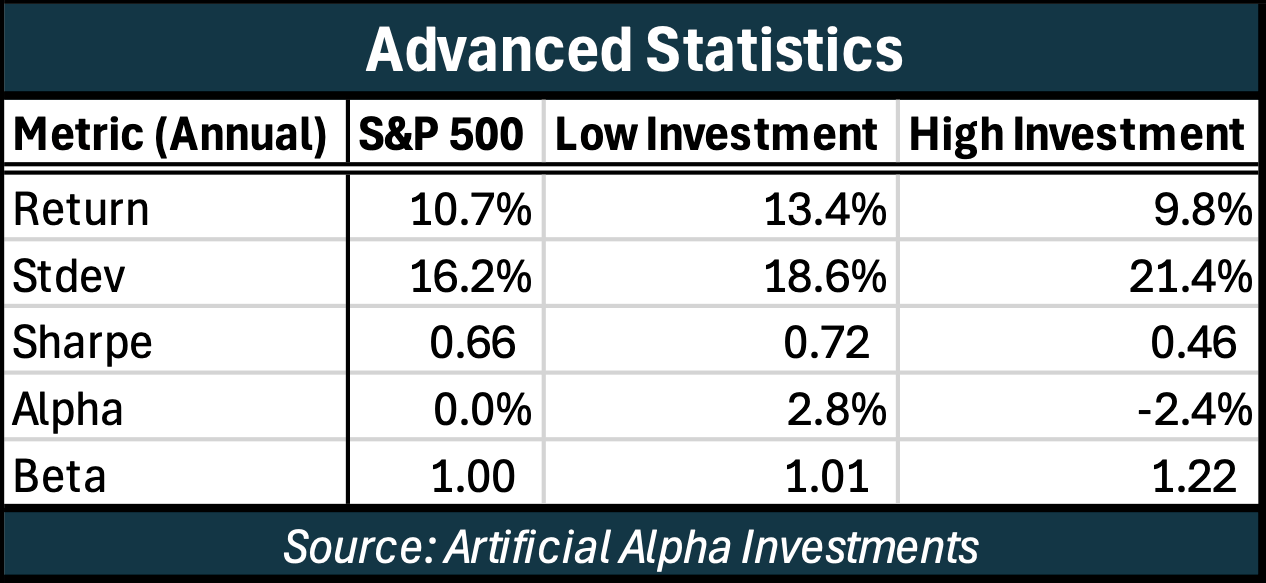
High investment businesses experienced a leading 21.4% stdev and a leading 1.22 Beta. Heavy investment does carry added risk. Higher risk normally results in higher returns. Not in this case.
The risks of heavy asset investment are real. The returns are generally disappointing.
Reconstructing the Narrative
Businesses that can return profits without the maintenance of all those pesky assets are most desirable. Mag7 businesses were once lauded for being especially “asset light”. I am generally pessimistic about businesses that pivot from asset light to asset heavy. Why would a business sacrifice an agile, asset light business?
My appreciation for asset light businesses (an appreciation that was vocalized by most market commentators until recently) contrasts with my skepticism for asset heavy businesses. I view heavy investment as an especially defensive move as opposed to an aggressive one. To my eye, the businesses participating the most in this (or any) investment boom are the ones with the most the lose.
AI is an outside force of disruption, not an inside force of power.
The stock market agrees so far that such incredible investments are becoming undesirable in their scope. High investment businesses, those being the businesses within the top quintile of y/y asset growth, have returned 2.95% year to date (as of July 1, 2026). Compare those results with a 17.53% year to date return for low investment businesses.
Conclusion
I am amazed by the scale of business investment being made across the stock market. There is certainly a bar that can be cleared for those investments, but history indicates a high bar.
Although I deploy a different measurement for Investment than the literature, clients may notice that their Large-Cap Value investments are concentrated among businesses with low investment. I do not know of an ETF that efficiently deploys this concept.

The most trying moments of active investment come when active portfolios begin to diverge from the narrative. From my perspective, business investment is becoming one of those misguided narratives and 2026 is becoming one of those divergent moments.
Disclosures & Risk Information: This commentary is for educational purposes only and represents the author’s opinions as of August 2026. It does not constitute personalized investment advice or a solicitation to buy, sell, or adopt any specific security or strategy (including Artificial Alpha’s Large-Cap Value Portfolio). Referenced indices and academic portfolios are unmanaged, do not incur fees, and cannot be invested in directly. All investing involves risk, including the potential loss of principal. Themes discussed carry unique risks: datacenter and AI infrastructure investments face high volatility and rapid obsolescence, while value-oriented or “low-investment” strategies may underperform broader markets. Historical market cycles (such as the dot-com boom) do not necessarily predict future outcomes. Past performance is no guarantee of future results.